Demand accountability for police collaboration in the South Burlington ICE raid
Posted Thu, 03/26/2026 - 9:06am
On March 11th, heavily armed ICE agents violently and illegally detained three community members in their home in South Burlington, Vermont. Agents broke down the door, entered with guns drawn, brutally handcuffed the non-resistant residents – including an 18-year-old U.S. citizen – and detained Cristian Jerez and sisters Johana and Camila Patin.
Following mass public outcry – and near constant rallies outside the Vermont federal courthouse last week – Johana, Cristian, and Camila have all been freed and reunited with their families. In orders releasing the three, federal judges excoriated ICE’s blatant constitutional abuses, writing in one ruling that they “had to confront the extraordinary context in which [the] arrest took place. The Government has adopted a policy of mass detention for immigrants despite the constitutional limitations on civil detention… [The] arrests are the product of being in the wrong place at the wrong time.” Judges concluded that “[o]nly immediate release could abate the constitutional harm.”
The sad reality is that arrests like these are not unique. Migrant Justice documented over 100 detentions of immigrant Vermonters last year, many of them violent and unlawful. Unconstitutional detentions have been the cornerstone of Trump’s national immigration policy.
What was unique about 3/11 was not ICE’s unconstitutional policing but the mass community resistance to ICE’s assault – and the collaboration of state and local police aiding ICE in overcoming that community resistance.
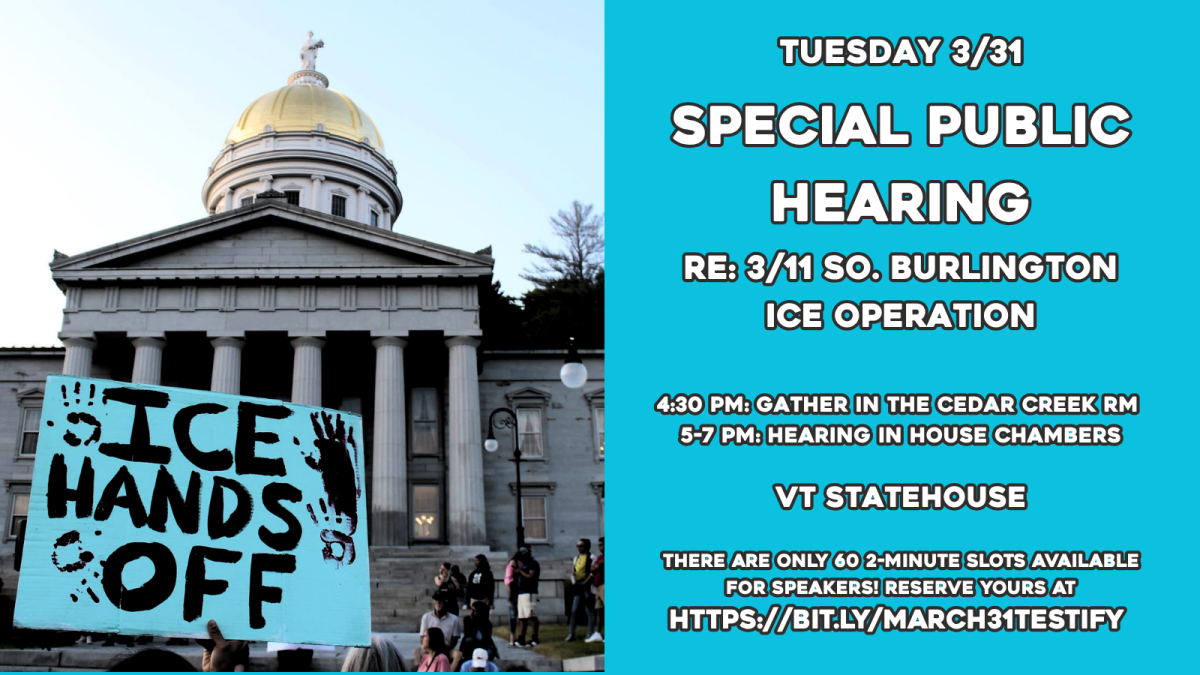
Join Migrant Justice at the Vermont State House on Tuesday, 3/31 at 4:30pm. Speak out to say no to police collaboration with ICE in VT!
ICE’s actions on 3/11 began with an act of racial profiling: an agent looking for an immigrant with a prior deportation wrongly claimed that the Latino driver of a car fit the description of the man he was investigating, leading to a car chase near a school zone. (ICE has since admitted the error, with the agent writing “I no longer believe” that the subject of the investigation was in the car.) This chase led agents to a house on Dorset St. in South Burlington where multiple families reside. ICE then surrounded the house.
Residents called Migrant Justice’s emergency hotline, leading us to activate our rapid response network. Hundreds of Vermonters mobilized to protect their immigrant neighbors and stop ICE from entering the home. As in previous cases – including at a Burlington home just two days prior – protectors linked arms around the home in a display of courageous solidarity, putting their bodies between armed federal agents and the families who they sought to tear apart.
The mass community response caused ICE to rethink their actions, with the head agent on site texting a supervisor (as revealed in excellent reporting from The Rake): “We may have to withdraw, we have like 100 people on strike [likely he meant ‘site’].” Ultimately, agents chose a different course of action: ICE called on local police for backup to help them break the lines of community protectors and enter the home.
South Burlington, Burlington, Vermont State Police arrived at ICE’s request, establishing with ICE a joint command post in South Burlington City Hall and planning a coordinated assault on the home. The arrival of VSP’s “Critical Action Team” in riot gear and masks finally provided ICE with the firepower they needed to overcome the community protectors.
With a warrant in hand for the arrest of their target for “unlawful reentry” (returning to the US after a prior deportation) – an individual who was not in the home and had never been on the scene that day – ICE and police forced their way in. State and local police violently pushed neighbors back, forming a cordon for ICE to break down the door, enter the home, and assault the residents. While in the home, an agent’s foot broke through the floor and he fired a weapon, which may have been either a pistol or a stun grenade.
Once ICE realized the person named on their warrant was not present, they simply rounded up anyone they could find. ICE detained Johana, Cristian, and Camila, according to court documents: “after asking the occupants if they had ‘papers to be here,’ and after the occupants responded that they were ‘in the process.’”
As local and state police continued to brutalize the lines of community protectors, ICE dragged Johana, Cristian, and Camila from their home into waiting cars, hitting people as they sped away. Police and ICE punched and shoved people, threw them to the ground, used pepper spray, tear gas, and flash bangs, and in one case choked a person to the point of losing consciousness. Much of this brutality has been extensively documented and widely viewed.
Since the horrifying police-ICE raid of March 11th, local and state police officials have presented an Alice in Wonderland version of events. Rather than arriving at ICE’s behest and coordinating actions with federal agents, police claim they were there to safeguard protestors’ right to free speech. Rather than assaulting and brutalizing community protectors, police say they prevented greater violence. They blame a “Trojan Horse” of “agitators” for the violence, despite ample documentation of unprovoked police brutality (see this video compilation for just one example).
In press releases, press conferences, and public hearings, Burlington, South Burlington and State Police officials have sought to create a narrative that twists events to avoid accountability. Despite claims of ongoing reviews, officials are preemptively exonerating themselves, patting themselves on the back for their departments’ “professionalism and restraint.” This lack of accountability prompted one incredulous lawmaker to marvel that the only lesson learned by police agencies appeared to be their intention to “change the color of windbreakers” to better distinguish themselves from ICE.
Vermonters are not fooled by officials’ misdirections, victim-blaming, and outright fabrications. We can see clearly that local agencies worked hand in glove with ICE to detain immigrant Vermonters and to brutalize the community defenders seeking to protect their neighbors.
Police collaboration with ICE occurred in clear violation of Vermont’s Fair and Impartial Policing Policy, which explicitly prohibits police from “accept[ing] requests by federal immigration authorities to support or assist in civil immigration enforcement” and from “facilitat[ing] the detention of individuals by federal immigration authorities for suspected civil immigration violations.”
As part of their justification, police have claimed that ICE’s actions on 3/11 were part of a criminal investigation, not civil enforcement. This claim is belied by the facts: ICE detained Johana, Camila, and Cristian without any criminal charges or suspicion of criminal offense. Even if one were to accept that claim, however, the policy still prohibits police collaboration. The policy states that “federal criminal immigration law is generally not a priority,” specifically naming the “unlawful reentry” charge that was used to justify the raid and discouraging police from “expend[ing] resources investigating or enforcing” such offenses.
To avoid accountability for these clear violations, police officials are misrepresenting the Fair and Impartial Policing Policy. They claim that the policy wasn’t written for “any situation that even remotely comes close to this.” In fact, the policy was written with these situations firmly in mind. Migrant Justice knows this because in 2016 we drafted the provisions in question precisely to prevent such collaboration.
We know that the police will not police themselves. This is why Vermonters must demand that elected officials – including the Burlington and South Burlington City Councils and the state legislature – take action to hold agencies accountable and ensure that this never happens again.
This fight for accountability will continue next Tuesday at the State House. For the past two weeks, police officials have been given ample airtime to present their narrative. At City Council meetings, well over 100 people have spoken out and provided testimony, but Tuesday’s hearing will be the first opportunity for the people to speak their truth without police being given the final word.
Read more about the 3/31 State House hearing and sign up to provide testimony in person, virtually, or in writing. Then join us in Montpelier at 4:30pm for the 5pm hearing!